Introduction
In 2026, every forward-looking school leader is thinking about how to build a government school hybrid classroom that can support both physical and online learners at the same time. India’s education system is going through rapid digital transformation, driven by national and state-level initiatives aimed at upgrading government school infrastructure. Programs like PM SHRI schools, ICT Labs, Digital India, smart classroom projects, and large-scale online teacher training are creating a strong foundation for hybrid learning environments across the country.
These initiatives are helping government schools move beyond traditional chalk-and-board teaching to technology-enabled classrooms with interactive digital boards, high-speed internet, and video conferencing tools. As budgets for smart classrooms, AI-based assessment, and digital content increase in states like Delhi, Tamil Nadu, and others, hybrid classroom setup in India is no longer a luxury but a practical necessity for continuity of learning and improved outcomes.
What Is a Hybrid Classroom?
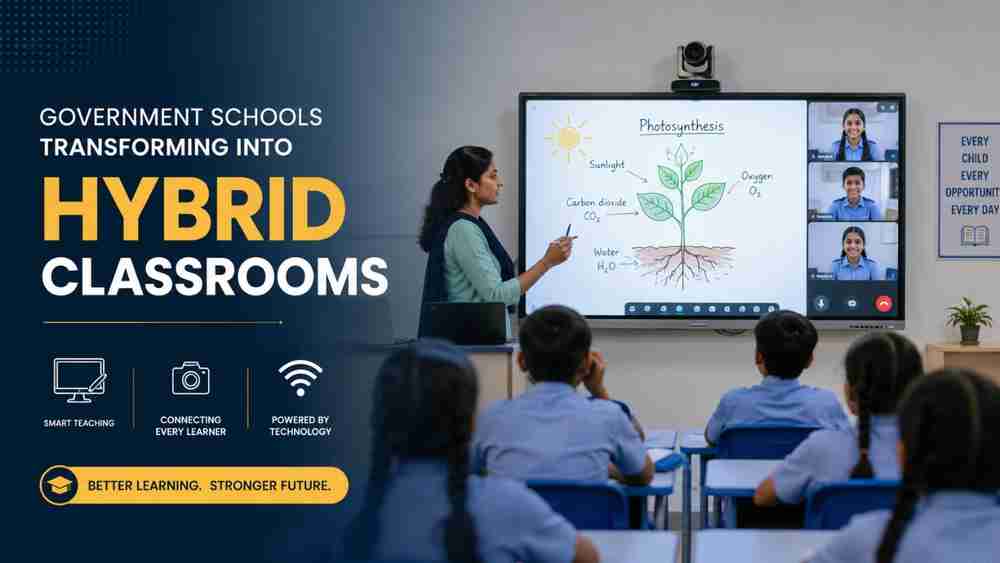
A hybrid classroom is a teaching space where students learning in the physical classroom and students joining online are taught together in real time. In hybrid learning, the same lesson is delivered simultaneously through offline teaching (in-person) and online platforms (video conferencing or streaming) so that no student is left behind.
In a government school hybrid classroom, the teacher typically uses an interactive digital board to teach, while a PTZ camera for schools captures the teacher and board view and sends live video to remote students. A good microphone system picks up the teacher’s voice clearly, and speakers ensure classroom audio is clear for everyone present.
Video conferencing platforms such as Zoom, Google Meet, or Microsoft Teams connect remote learners, record sessions, and enable interaction via chat and voice. Together, digital boards, PTZ cameras, microphones, and software create a seamless environment where teaching remains central but technology extends its reach.
Why Government Schools Need Hybrid Classrooms
Government schools in India face diverse challenges—large student numbers, teacher shortages, distance barriers, and disruption during emergencies. A well-planned government school hybrid classroom can address many of these issues.
Key reasons to adopt hybrid classrooms include:
- Teacher training and online workshops
District and state education departments increasingly conduct online training, webinars, and refresher courses. Hybrid classrooms allow teachers to join sessions from their own schools while trainers present from central hubs.
- Remote learning during emergencies
Whether it is a natural disaster, local disturbance, or health-related closures, hybrid classroom setup in India helps schools continue teaching via live online classes without fully shutting down.
- Access to quality education in rural areas
Remote and rural schools can connect to expert teachers and model schools from other districts or states. Hybrid classrooms allow subject experts to deliver lessons live while local teachers support classroom management.
- Recorded lectures for revision
PTZ camera for schools and digital boards can be used to record high-quality lectures. These recordings help students revise for exams and allow absent students to catch up later.
- Better classroom monitoring and reporting
Digital tools, cameras, and learning platforms generate data on attendance, lesson coverage, and student engagement. District officials can monitor teaching quality and support schools based on real-time information.
- Alignment with digital education initiatives
National Education Policy 2020, PM SHRI, ICT Labs, and state smart classroom schemes all emphasise technology integration. Hybrid classrooms help schools align with these priorities and leverage available funding.
Essential Equipment for a Government Hybrid Classroom
To build a robust government school hybrid classroom, schools need a combination of audio-visual equipment, computing devices, and connectivity. Below is a practical configuration suitable for most government schools.
Recommended Hybrid Classroom Equipment
Equipment | Purpose | Recommended Specification |
Interactive Digital Board | Teaching, content display, annotation | 65", 75", or 86" interactive flat panel; Full HD/4K resolution; wall-mounted; inbuilt PC or OPS |
4K PTZ Camera | Capturing teacher and board view | True 4K resolution (3840×2160), 10–12× optical zoom, auto-focus, remote pan–tilt–zoom |
Wireless/Lapel Microphone | Clear teacher audio | UHF digital wireless, noise cancellation, lapel or headset mic, minimum 30 m range |
Speaker System | Classroom audio output | 2.1 or 4.1 speaker system, 20–40W output, wall-mounted or shelf-mounted |
LED Lighting | Proper illumination for video recording | Energy-efficient LED panel lights, neutral white tone, glare-free |
Computer or Mini PC | Running software, content, and conferencing | i5 or equivalent processor, 8–16 GB RAM, 256 GB SSD, Windows 11 or latest OS |
High-Speed Internet | Stable live classes and recordings | Minimum 50 Mbps broadband or fibre connection; Wi-Fi router for classroom |
UPS/Power Backup | Uninterrupted teaching during power cuts | 1–2 kVA UPS for digital board, PC, and networking equipment; battery backup 30–60 minutes |
This combination ensures smooth operation of smart classroom for government schools and supports hybrid teaching without frequent technical disruptions.
Step-by-Step Transformation Process
Transforming a traditional classroom into a government school hybrid classroom requires planning and coordination, but the process is manageable when broken into clear steps.
1. Infrastructure Assessment
- Check classroom size, seating arrangement, wall strength, and electrical points.
- Review existing equipment such as projectors, speakers, or computers that can be reused.
2. Classroom Planning
- Decide the position of the interactive digital board so that all students can see it.
- Identify camera placement, microphone location, and cable routing to avoid clutter and safety issues.
3. Installation of Digital Board and Audio System
- Mount the interactive digital board securely with proper brackets.
- Install speaker system at suitable height for balanced sound distribution across the classroom.
4. PTZ Camera Mounting
- Fix the PTZ camera on a wall or ceiling mount facing the teacher and board.
- Configure camera presets for different angles (board view, teacher close-up, student view).
5. Software Setup
- Install and configure Zoom, Google Meet, or Microsoft Teams on the classroom computer or digital board.
- Create official school accounts, meeting templates, and basic guidelines for online sessions.
6. Teacher Training
- Conduct hands-on workshops for teachers on using interactive digital boards, cameras, and microphones.
- Train them in hybrid pedagogy—how to manage in-class students and online learners together.
7. Pilot Implementation and Evaluation
- Start with a few sections or subjects as a pilot government school hybrid classroom.
- Collect feedback from teachers, students, and administrators, and refine the setup based on real use.
Estimated Setup Cost in India (2026)
Costs can vary by brand, location, and exact specifications, but schools can plan approximate budgets:
- Basic hybrid classroom: ₹1.2 lakh–₹1.8 lakh
Suitable for smaller classrooms with a standard interactive digital board, Full HD PTZ camera, basic sound system, and essential lighting. - Advanced hybrid classroom: ₹2.5 lakh–₹5 lakh
Includes a larger interactive digital board (75" or 86"), 4K PTZ camera for schools with auto-tracking, higher-end audio system, professional lighting, and better computing hardware.
Actual cost depends on classroom size, number of students, selected brands, and equipment quality. Schools should compare multiple GeM-listed classroom solution provider options and factor in warranty, installation, and training support rather than just the hardware price.
How Government Schools Can Purchase Through GeM
Government e-Marketplace (GeM) is the central online platform used by government departments, schools, and institutions for procuring goods and services. It ensures that procurement is transparent, compliant, and aligned with government rules.
The typical process is:
- The school or department creates a requirement and specification for hybrid classroom setup in India.
- GeM is used to search and shortlist vendors offering interactive digital board for government schools, PTZ cameras, audio systems, and related services.
- Requests for quotation (RFQ) or bids are published on GeM, and approved vendors respond with pricing and technical proposals.
- The school or department evaluates offers, checks ratings and past performance, and issues a purchase order through GeM.
Buying from a GeM-listed classroom solution provider offers multiple benefits: standardised terms, verified suppliers, better price discovery, and clear audit trails. It also simplifies approvals at district and state levels because the procurement follows government-approved processes.
How Edumark Technologies Helps Government Schools
Edumark Technologies is a professional partner for building government school hybrid classroom solutions and is listed on the Government e-Marketplace (GeM). Being present on GeM allows education departments, government schools, and colleges to purchase from Edumark using standard government procurement workflows.
Edumark provides:
- Interactive digital board for government schools in multiple sizes (65", 75", 86").
- 4K PTZ teaching cameras, microphones, speakers, lighting systems, computers, and complete hybrid classroom infrastructure.
- End-to-end services: site survey, installation, configuration, and integration with Zoom, Google Meet, and Microsoft Teams.
- Teacher training programs focused on hybrid pedagogy and use of digital tools in everyday teaching.
- Technical support and after-sales service so that equipment runs smoothly over the long term.
By working with Edumark Technologies, education departments can implement scalable, future-ready hybrid classroom solutions across India that are compatible with PM SHRI, ICT Labs, and other smart classroom for government schools initiatives.
Real-World Use Cases
A properly designed government school hybrid classroom can support many practical use cases:
- District-level teacher training sessions where master trainers speak from a central studio and hundreds of schools join live.
- Live online classes for remote students who cannot attend physically due to health, distance, or special circumstances.
- Recorded lectures for exam preparation, created using digital boards and PTZ camera for schools, and shared with students via school portals or messaging apps.
- Interaction with subject experts from other cities or states, allowing rural schools to access high-quality instruction without travel.
- Monitoring of teaching quality through recordings, lesson logs, and analytics dashboards, helping education officers support and mentor teachers more effectively.
These use cases show that hybrid classrooms are not just about technology; they are about expanding learning opportunities and improving governance.
Conclusion
Hybrid classrooms are becoming essential for every future-ready government school in India. A well-planned government school hybrid classroom aligns with national digital education initiatives, improves teaching quality, and ensures that learning continues even during disruptions.
By investing in scalable digital infrastructure, training teachers, and partnering with reliable GeM-listed classroom solution provider organisations like Edumark Technologies, schools can build sustainable hybrid systems that serve students for years. Proper planning, step-by-step implementation, and strong technical support can significantly enhance student engagement, examiner readiness, and overall academic outcomes—making the government school hybrid classroom a cornerstone of modern education.
Contact Edumark Technologies
For consultation, detailed proposals, and implementation support:
- Phone: 8002805461
- Website: www.edumarktechnologies.com
- Email: info@edumarktechnologies.com
School principals, district education officers, and education department officials can connect with Edumark Technologies to plan and deploy customised hybrid classroom setup in India for their institutions.